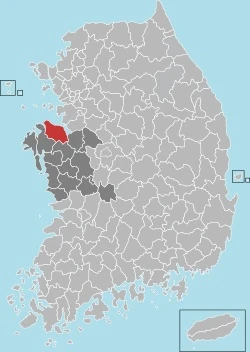
Dangjin (Korean: 당진; Korean pronunciation: [taŋ.dʑin]) is a city in South Chungcheong Province, South Korea. It stands on the south shore of the Bay of Asan. Dangjin borders Incheon, Pyeongtaek, and Hwaseong by sea, and Seosan, Yesan, and Asan by land. Its name means "Tang ferry," and refers to the historic role of Dangjin's harbor in connecting Korea to the other side of the Yellow Sea. This role continues to be important in the city's economy, which relies on a mixture of agriculture and heavy industry. The city has the same Hanja name (唐津市) as Karatsu in Saga Prefecture, Japan.
Administrative divisions
The city is divided into 2 eup, 9 myeon and 3 dong.
History
The name "Dangjin" was first used to refer to this area during the Joseon period. From 1413 to 1895, it was known as Dangjin-hyeon, a division of Chungcheong Province. The city achieved its present borders in 1973, with the merger of a portion of Jeongmi-myeon into Seosan's Unsan-myeon. It was originally a county but was promoted to a city on January 1, 2012, after a rapid population boost.
Being on the Yellow Sea, the port has been important for trade with China, and since early times was defended against foreign invasion by becoming a fortress city (Eupseong). According to legend, the eupseong was built in the 16th year of King Chungyeol (1290 AD), but it is currently believed to have been built during the Baekje period and modified throughout the Joseon period to prevent foreign invasion. Mianchuan Eupseong is a city with four gates in the east, west, south, and north. It was rebuilt in the 13th year of King Taejong of the Joseon Dynasty, and it was rebuilt during the reign of King Gyeongjong.
Education
As of March 2005, in Dangjin there were 33 elementary schools, 12 middle schools, and 38 preschools, serving 14,293 students. In addition, there were 8 high schools. All of these organs are overseen by the Dangjin Office of Education.
There are some institution of higher education in the city is Shinsung College (신성대학교), Hoseo University (호서대학교).
Economy
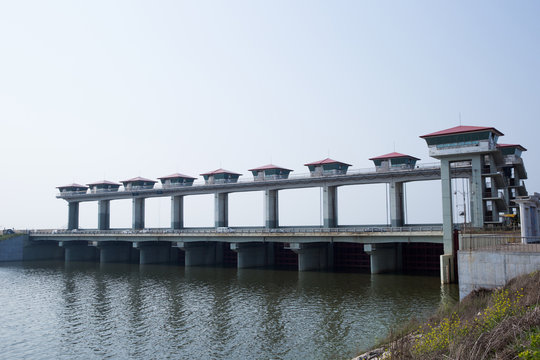
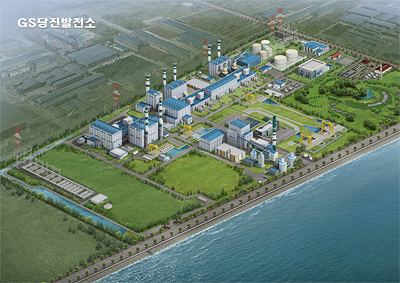
Dangjin is home to a number of factories, including steel mills operated by Hyundai Hysco and Hyundai INI Steel. These factories are supplied in part by ships docking at Dangjin Harbor, a cargo port with 5 piers, two of which are dedicated to steel coil shipping.
Tourism
Dangjin, located on the western coast of South Korea, offers a blend of coastal charm, historical landmarks, and religious heritage. With easy access from Seoul and other major cities, it has become an appealing destination for domestic travelers seeking both cultural experiences and natural beauty. The city’s shoreline along the Yellow Sea provides opportunities for scenic drives, peaceful walks, and sunset viewing, while inland areas feature temples, fortresses, and pilgrimage sites that reflect the region’s rich history. Local festivals, traditional cuisine, and modern amenities also contribute to its growing tourism appeal.
- Solmoe Holy Ground: This site is the birthplace of Saint Andrew Kim Taegon, the first Korean Catholic priest and martyr. It features a chapel, memorial hall, and walking paths surrounded by forest, attracting thousands of Catholic pilgrims and visitors interested in Korea’s religious history.
- Yonghyeon-ri Coastal Road: A scenic stretch along the Yellow Sea, this coastal road is especially known for its sweeping ocean views, peaceful atmosphere, and dramatic sunsets. It’s a popular destination for couples, photographers, and travelers seeking a relaxing drive near the sea.
- Gagok-myeon Wind Farm: Located on rolling hills, this wind farm is not only an energy production site but also a tourist attraction. The large wind turbines set against expansive fields and open skies create a striking visual landscape that draws visitors, especially during spring and fall.
- Haemi Fortress: A historic fortress dating back to the Joseon Dynasty, Haemi Fortress is significant for its association with the persecution of Catholics in the 19th century. The fortress grounds include stone walls, gates, and open fields, offering insights into Korea’s military and religious history.
- Sudeoksa Temple: Though technically near the border with Yesan, this temple is frequently visited by those staying in Dangjin. Sudeoksa features ancient wooden architecture, serene forest surroundings, and ongoing monastic training, making it one of the key Buddhist sites in the region.
Notable People
Entertainment
- Aiki, dancer, choreographer, and TV personality
- Geum Bo-ra, actress
- Taehwan (Vanner), singer
Society
- Saint Andrew Kim Taegon, Catholic priest and patron saint of Korean clergy
- Chong Moon Lee, entrepreneur and philanthropist
- Kim Na-rae, pastry chef
- Song Young-jin, politician
Sports
- Choi Yong-soo, boxer
- Gim Eun-ji, curler
- Han Myung-woo, wrestler and Olympic gold medalist
- Kim Gi-dong, footballer and coach
- Kim Gi-jung, badminton player
- Lee Jong-sung, footballer
- Park Sung-woo, badminton player and coach
- Seo Myeong-won, footballer
- Sin Hyeon-ju, sports shooter
- Yoo Yong-sung, badminton player and two-time Olympic medalist
Sister cities
Overseas Sister Cities
- Snohomish County, Washington, United States
- Rizhao, Shandong, China
- Daisen, Akita, Japan
References
External links
- City government website